


The Competition Council of Latvia (CC) has concluded its market monitoring of wood pellets used for heating, finding that the significant increase in pellet prices observed over the past year was not caused by any single factor. The increase was primarily driven by rising production costs, limited availability of raw materials and finished products, higher demand resulting from a cold winter, increased export volumes and the discontinuation of previously significant pellet imports from Belarus. At the same time, the CC's price monitoring did not identify any indications that would provide sufficient factual grounds to suspect possible coordinated conduct among the pellet retailers and wholesalers monitored.
The CC began examining the wood pellet market in July 2026 in response to rising pellet prices and concerns about their availability ahead of the 2026/2027 heating season. During the study, the CC surveyed six pellet retailers and 16 wholesalers and producers, analysing pricing mechanisms, cost developments, competitive conditions and changes in retail prices.
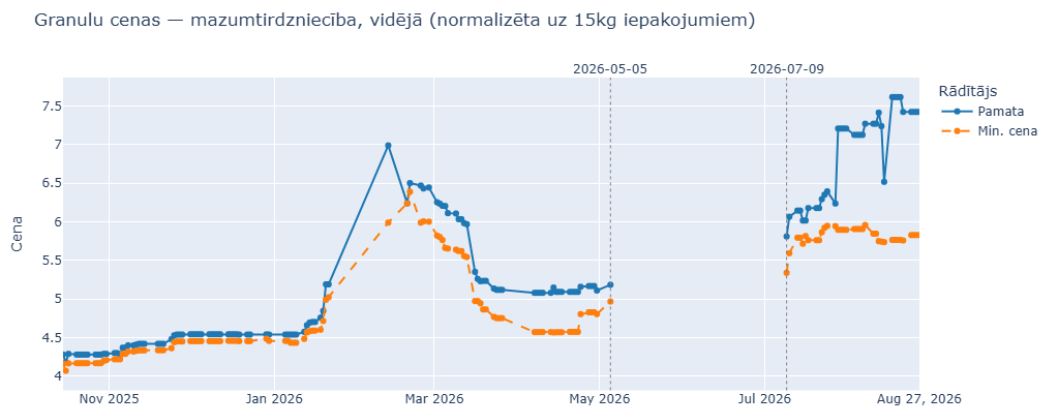
The CC also monitored the prices of selected pellet retailers from October 2025 and, from July 2026, expanded its price monitoring to cover both retailers and wholesalers. The monitoring data confirm that the market is not homogeneous in terms of either pricing or product availability. Market participants differ in their price levels, the timing, frequency and direction of price changes, as well as product and stock availability. Consequently, the CC did not identify any price similarities or simultaneous price changes which, considered alongside the other information available to the CC, would provide sufficient factual grounds to suspect possible coordinated conduct among the retailers and wholesalers monitored.
Base price of wood pellets increased by approximately 73% over the year
The CC's price monitoring data show that between October 2025 and the end of August 2026, the average base retail price of a 15 kg bag of wood pellets increased from approximately €4.28 to €7.42, representing a rise of around 73%. Meanwhile, the average minimum price, including discounted offers, increased from €4.16 to €5.83, or by 40%.
The most pronounced fluctuations in prices and availability were observed during periods of increased demand – the 2025/2026 heating season and the summer of 2026, as consumers prepared for the following heating season. During certain periods, pellets were unavailable from several retailers, or only a limited range of products was offered.
The CC concluded that pellet procurement costs had the greatest impact on final retail prices. Data obtained by the CC indicate that approximately 70% of the retail price of pellets consists of procurement costs. At the production level, raw materials account for approximately 60% of total costs, with the remainder comprising electricity, labour, packaging, transport, equipment maintenance and other expenses.
Rising pellet exports and declining imports increase pressure on domestic market prices
The CC's study found that the Latvian wood pellet market is closely linked to export markets. In the first half of 2026, the export volume of pellets produced in Latvia was approximately 27% higher than in the corresponding period of 2025, returning to approximately the level recorded in 2024.
Almost all surveyed pellet producers and wholesalers indicated that export demand directly or indirectly affects pellet prices in Latvia. During periods when selling products on foreign markets is more financially attractive for producers, Latvian consumers effectively compete with consumers in other European countries for the available supply. This reduces the volume of pellets available on the domestic market and creates upward pressure on prices.
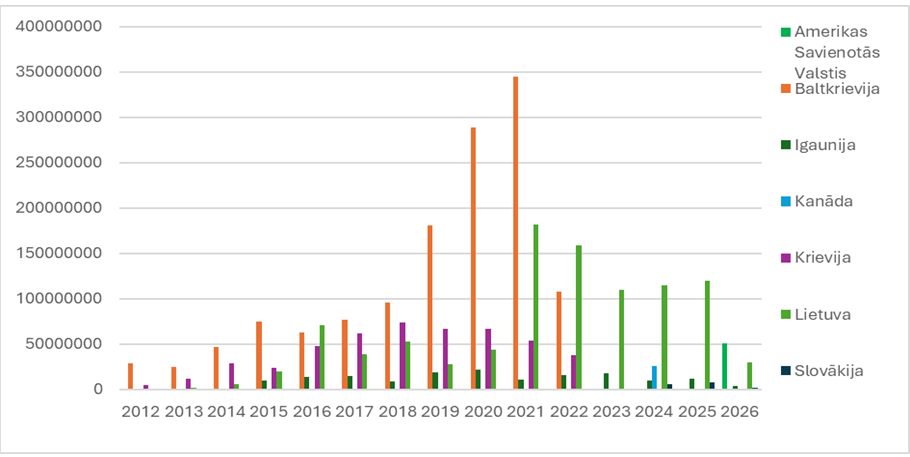
The situation has also been affected by a decline in pellet imports following the introduction of European Union sanctions on pellet imports from Russia and Belarus in 2022. Notably, Belarus had previously been the most significant source of pellet imports, with approximately 345,000 tonnes imported into Latvia from Belarus in 2021. The loss of this import source has reduced the ability to compensate for shortages in domestic supply through imports during periods of high demand.
Volume of wood pellets imported into Latvia, 2012–2026, in kilograms
Purchasing wood pellets in advance can reduce risks associated with seasonal demand
The CC's market monitoring found that the wood pellet market is particularly sensitive to fluctuations in demand and product availability. The cold winter of 2025/2026, combined with insufficient stockpiling in advance, led to a sharp increase in demand, which the available pellet supply was unable to fully meet during certain periods.
The CC therefore considers that the Ministry of Climate and Energy, in cooperation with industry organisations, should continue the engagement with industry representatives initiated in spring 2026 to ensure ongoing assessment and understanding of developments in the wood pellet market.
At the same time, it would be beneficial to work with industry representatives to provide consumers and market participants with timely information on pellet supply conditions, seasonal production shutdowns and other significant market trends. Timely access to such information would help consumers and market participants prepare for and adapt to potential market changes, including situations where increased demand could pose risks to fuel availability and the reliability of supply.
Source: Official foreign trade statistics compiled by the Central Statistical Bureau of Latvia. Available at: https://eksports.csb.gov.lv/lv/years/products-selected/export/2005-2026-2026/TOTAL-IX-44-4401-440131/TOTAL