


The Competition Council (CC), in response to the sharp increase in fuel prices observed during the second quarter of 2026, the impact of geopolitical developments in the Middle East on the fuel market, and concerns raised by consumers regarding price changes, carried out an in-depth assessment of the fuel and autogas markets in Latvia. By analysing fuel price developments, wholesale purchase prices, the impact of the temporary reduction in excise duty, and developments in the autogas (LPG) market, the CC has compiled its key findings on market developments during the first half of 2026.
Petrol and Diesel Prices
The CC's analysis indicates that the increase in the retail prices of 95-octane petrol and diesel was primarily driven by a sharp rise in wholesale fuel purchase prices on international markets. The information gathered does not suggest that the price increase resulted from a significant expansion of retailers' margins.
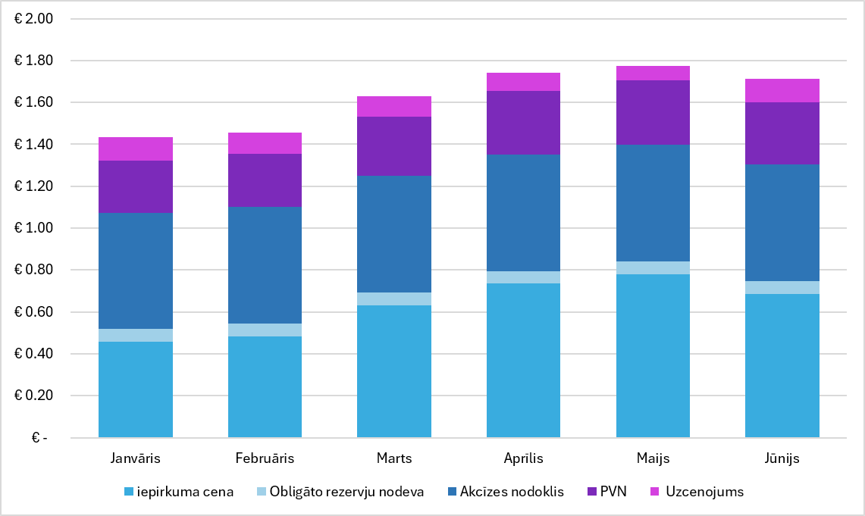
With regard to retailers' margins on 95-octane petrol, the CC found that they not only did not increase, but gradually declined from an average of EUR 0.111 per litre in January to EUR 0.070 per litre in May. This trend indicates that retailers absorbed part of the increase in wholesale purchase prices by reducing their own margins during the period. In June, as wholesale purchase prices declined, retail petrol prices also fell, while retailers' margins returned to approximately the level observed in January.
Figure 1
Components of the Average Retail Price of 95-Octane Petrol (After Discounts), January - June 2026
Source: CC calculations based on data provided by market participants.
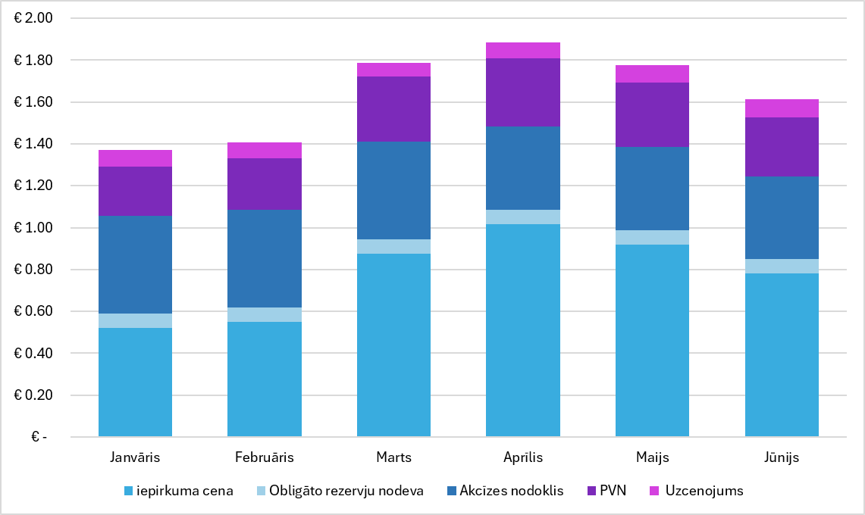
With regard to diesel prices, the CC concluded that retailers' margins remained relatively stable throughout the period analysed, fluctuating between EUR 0.066 and EUR 0.089 per litre. During the period when wholesale purchase prices reached higher levels, the average retail margin declined from EUR 0.077 per litre in January to EUR 0.066 per litre in March, indicating that retailers also absorbed part of the increase in wholesale purchase prices by reducing their own margins. From May onwards, as wholesale purchase prices declined, retail diesel prices also gradually decreased, while retailers' margins increased progressively, reaching EUR 0.089 per litre in June.
Figure 2
Components of the Average Retail Price of Diesel (After Discounts), January - June 2026
Source: CC calculations based on data provided by market participants.
At the same time, the CC emphasises that the retail margin does not fully reflect a retailer's profit. It also covers the costs associated with fuel retailing, including logistics and transportation, fuel storage, the operation and maintenance of filling stations, employee remuneration, as well as other administrative and operating expenses.
CC Findings on the Reduction of Excise Duty on Diesel Fuel
The CC also carried out a preliminary assessment of how the reduction in the excise duty on diesel, introduced on 1 April 2026, was reflected in pump prices, i.e. retail prices before the application of discounts. It was expected that the reduction in the excise duty rate would lower diesel prices by approximately 8.6 euro cents per litre, including VAT.
The impact of the excise duty reduction was assessed by analysing price developments before and after its introduction while taking into account other factors affecting fuel prices. The analysis was primarily based on data covering the period from 1 January to 22 June 2026.
The pass-through of the excise duty reduction was evaluated using two econometric methods. The main assessment was conducted using a weekly panel data regression model. The model controlled for changes in wholesale diesel prices by using Platts diesel price quotations and, in certain specifications, also included retail diesel prices in Estonia as a control variable representing a comparable market.
The CC concluded that, throughout the period during which the reduced excise duty was in force, diesel pump prices were on average 4.95 euro cents per litre lower than they would have been without the tax reduction. This corresponds to an estimated pass-through of approximately 58% of the excise duty reduction to final consumer prices.
The CC also found that the degree of pass-through was not uniform over time. The most pronounced price reduction was observed during the first week following the reduction in the excise duty rate. Thereafter, the effect gradually weakened and, from 6 April 2026 onwards, stabilised at approximately 4.52 euro cents per litre, equivalent to around 53% of the expected tax reduction. This indicates that the initial price response was stronger than the sustained effect observed in the following weeks.
The robustness of the results was further tested using the Synthetic Difference-in-Differences (SDID) method. Under this approach, developments in diesel prices in Latvia following the excise duty reduction were compared with a synthetic control group constructed from several European Union Member States where no changes in excise duty occurred during the same period.
The Synthetic Difference-in-Differences estimates indicated a pass-through rate of approximately 61–64%, depending on the pre-treatment period included in the analysis. These results are consistent with those obtained from the main panel data regression model and confirm that the findings are robust and do not materially depend on the methodology or analytical period selected.
Overall, the CC's econometric analysis indicates that the excise duty reduction provided consumers with a significant benefit from the beginning of April until the end of June. However, the pass-through of the tax reduction to pump prices was not complete, with approximately 58–64% of the tax reduction being reflected in diesel pump prices.
The CC emphasises that incomplete pass-through of the excise duty reduction to pump prices does not, in itself, indicate that fuel retailers increased their retail margins. The data available to the CC show that retail margins remained broadly stable during the period analysed. Consequently, part of the tax reduction may also have been passed on to consumers through other means, such as larger or longer-lasting discounts, which were not assessed separately in this analysis.
Comparison of Fuel Prices Across the Baltic States
The CC concluded that fuel price developments and price levels in Latvia were broadly in line with those observed in the other Baltic States, while Latvian fuel prices remained below the European Union average for most of the period analysed.
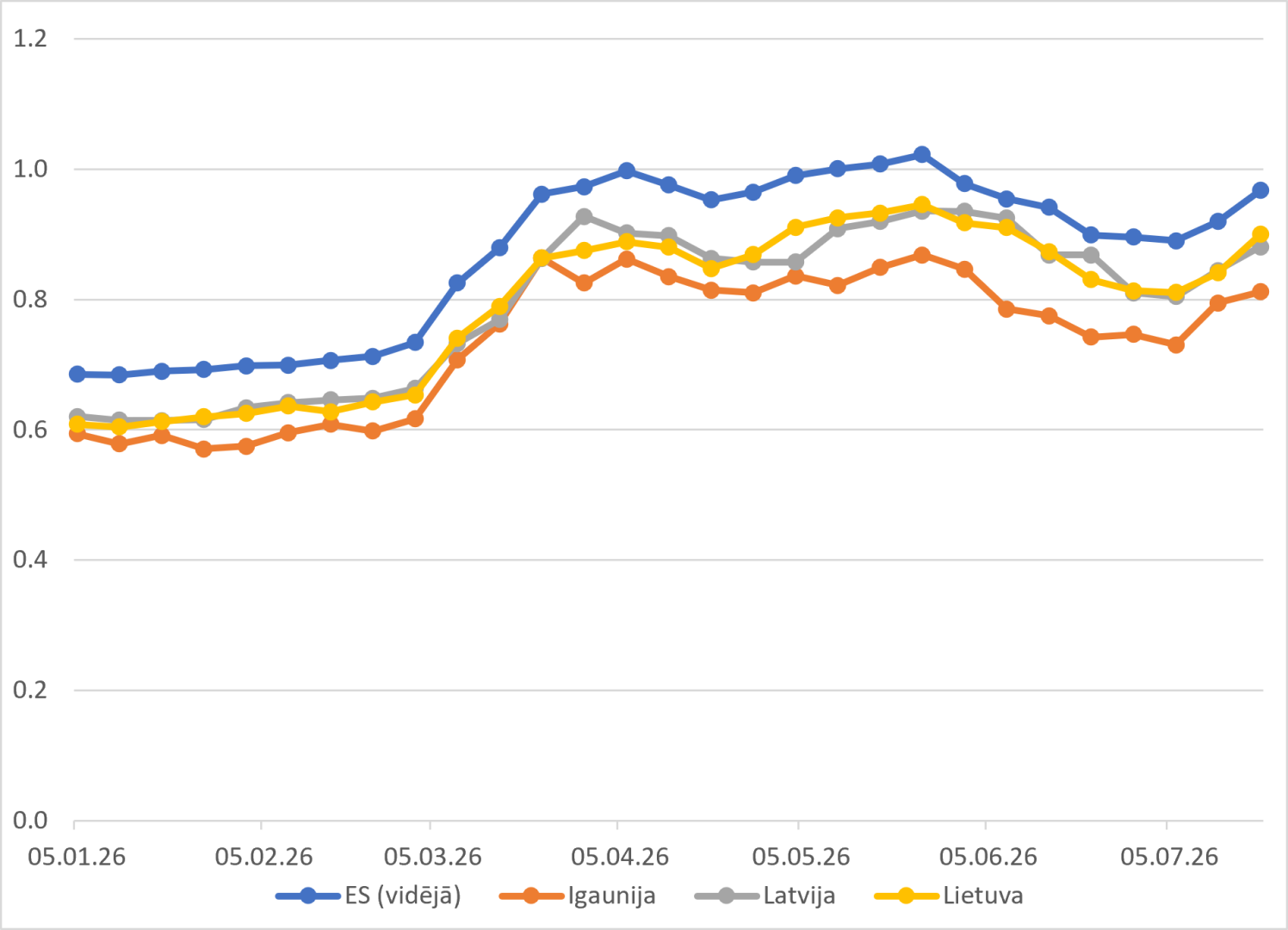
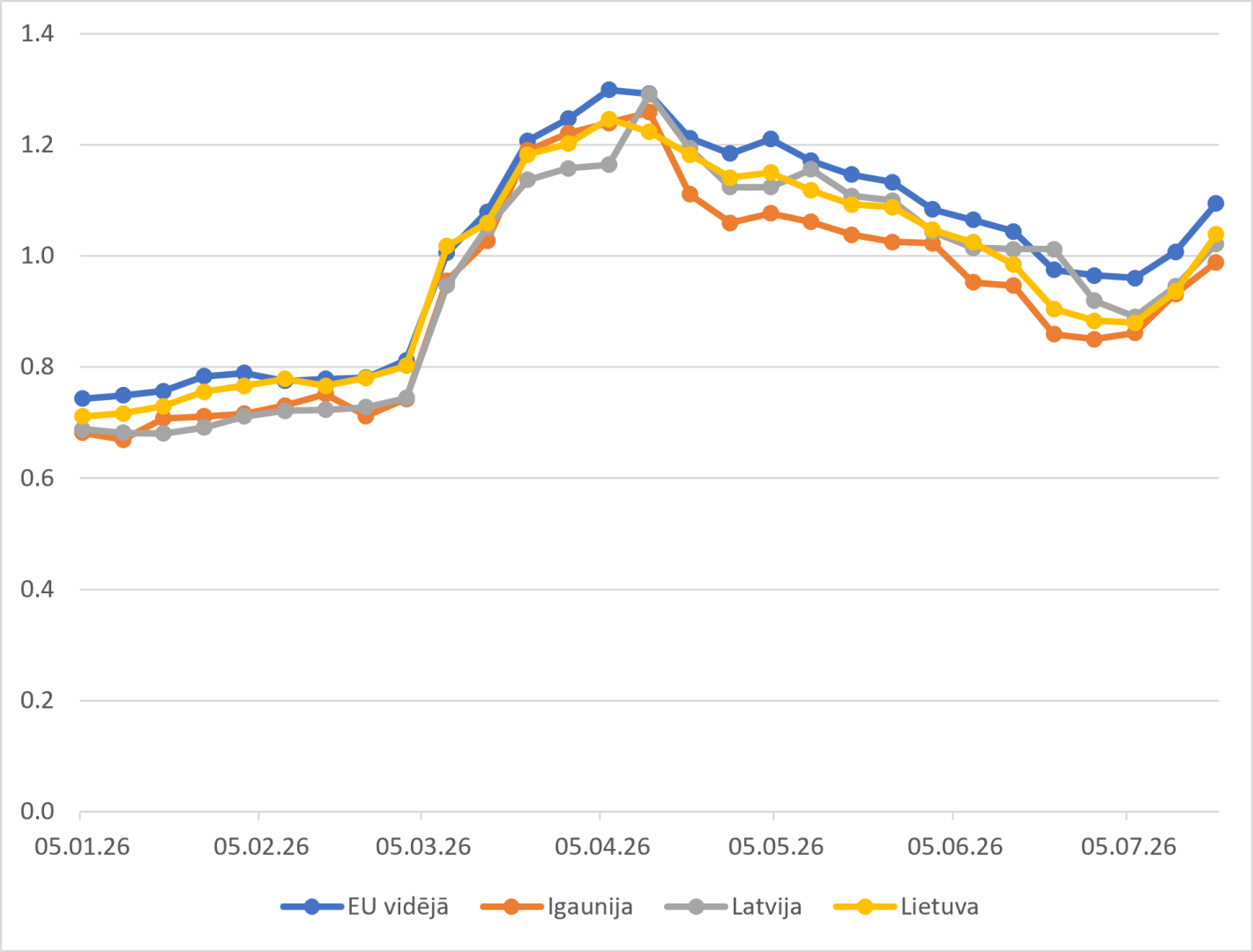
Based on a comparative analysis of the average pre-tax prices of 95-octane petrol and diesel between January and July 2026, the CC found that fuel price trends in Latvia closely mirrored those in the other Baltic States and the European Union as a whole (see Figures 3 and 4). In all countries included in the comparison, prices increased sharply in March, followed by a period of stabilisation and a gradual decline in June, before rising again towards the end of July.
Figure 3
Comparison of Average Pre-Tax Prices of 95-Octane Petrol in the EU, Latvia, Lithuania and Estonia
(EUR/litre, January - July 2026)
Source: Data compiled by the CC from Weekly Oil Bulletin https://energy.ec.europa.eu/data-andanalysis/weekly-oil-bulletin_en
Figure 4
Comparison of Average Pre-Tax Diesel Prices in the EU, Latvia, Lithuania and Estonia
(EUR/litre, January–July 2026)
Source: Data compiled by the CC from Weekly Oil Bulletin https://energy.ec.europa.eu/data-andanalysis/weekly-oil-bulletin_en
LPG prices
The CC's assessment of the LPG market indicates that price developments in this segment were also primarily driven by rising wholesale purchase costs and other objective market factors. These included volatility in energy markets, geopolitical developments affecting the Strait of Hormuz, constraints on oil supplies, increased transportation and logistics costs, as well as fluctuations in the EUR/USD exchange rate.
With regard to taxation, the CC found that the fiscal burden applied to LPG retail prices in Latvia is higher than in Estonia and Lithuania. A comparison of excise duty rates across the Baltic States shows that Estonia applies the lowest excise duty on LPG, at EUR 193.00 per tonne, while Lithuania applies the highest rate, at EUR 370.90 per tonne. In Latvia, the excise duty amounts to EUR 343.00 per tonne, which is approximately 77.7% higher than in Estonia and around 8.1% lower than in Lithuania.
In addition to VAT and excise duty, the retail price of LPG in Latvia includes a charge for maintaining the national strategic petroleum reserves, amounting to EUR 81.26 per 1,000 kilograms of petroleum products. By contrast, according to publicly available information, Estonia applies strategic petroleum reserve charges only to petrol, diesel, aviation fuel and heavy fuel oil. In Lithuania, publicly available information indicates that strategic petroleum reserves are financed from the state budget and are maintained only for petrol and diesel.
In light of the above, the CC found no indications that the increase in LPG prices was driven by any significant increase in retailers' margins.
Figure 5
Breakdown of the LPG Retail Price
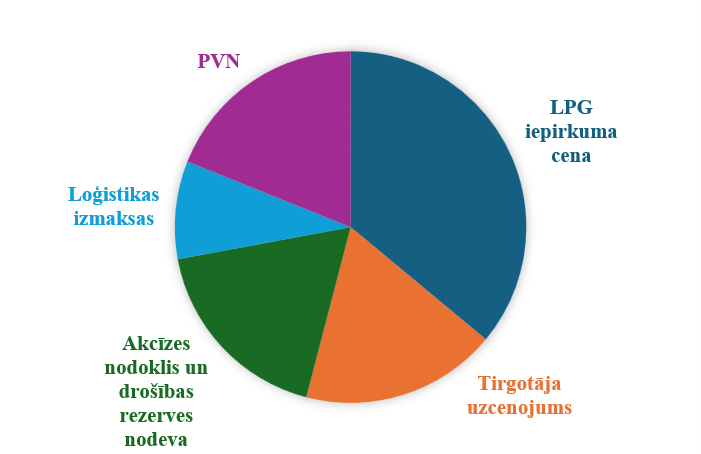
Source: CC calculations based on data provided by market participants.
The CC will continue monitoring the fuel and LPG markets until the end of 2026. As part of its ongoing assessment, the CC will continue to evaluate developments in fuel retail margins, the pass-through of the reduction in excise duty to diesel prices, complete its assessment of the LPG market, and finalise its analysis of the fuel wholesale market.
The final market monitoring report is scheduled for publication in February 2027.